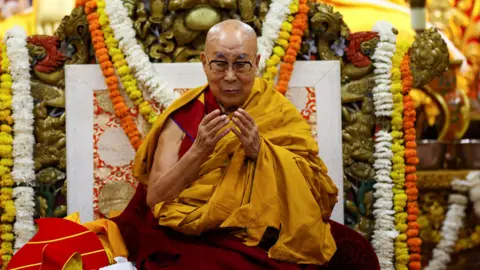
China has reacted angrily to an unlikely winner at the Grammys - the Dalai Lama - saying it opposes art awards being used for 'anti-China political manipulation'. The Buddhist spiritual leader was recognised in the audiobook category for Meditations: The Reflections of His Holiness the Dalai Lama. The Dalai Lama said he accepted the award with 'gratitude and humility'. The 90-year-old has lived in exile from his Tibetan homeland since 1959 and is condemned as a rebel and separatist by Beijing. China's foreign ministry spokesman Lin Jian stated: 'We firmly oppose relevant parties using art awards as a tool for anti-China political manipulation.' The Dalai Lama, who resides in Dharamshala, India, fled China after an uprising was crushed. He has campaigned for more autonomy for Tibet, perceived by Beijing as an integral part of China. He acknowledged the recognition, stating that he views it not as a personal achievement but as a recognition of 'our shared universal responsibility.' The award was collected on his behalf by musician Rufus Wainwright, who contributed to the audiobook. Last year, the Dalai Lama announced plans to name a successor, escalating tensions with China. According to Tibetan Buddhist tradition, the Dalai Lama is reincarnated after death, a process rooted more in spiritual custom than political authority. He has indicated that his reincarnation would occur in the 'free world,' thus infuriating Beijing, which insists that any succession must adhere to Chinese law and be sanctioned by the government.
Beijing Denounces Dalai Lama's Grammy Win as a Political Manipulation
Beijing Denounces Dalai Lama's Grammy Win as a Political Manipulation
China criticizes the recognition given to the Dalai Lama at the Grammy Awards, calling it an instance of political usage of art awards. The Dalai Lama remains a controversial figure for Beijing, which views him as a separatist.
The Dalai Lama's recent Grammy win for his audiobook has drawn sharp criticism from China, which accused the event of being manipulated for anti-China sentiments. While the 90-year-old spiritual leader accepted the award with gratitude, he continues to navigate tense relations with Beijing, which has condemned his aspirations for Tibetan autonomy.