In brief
The Terra Nova, the ship that carried Captain Scott on his ill-fated expedition to the South Pole, has been filmed for the first time in detail on the ocean floor. The footage showcases the vessel colonized with marine life, while still retaining key features like the wheel and mast. Discovered in 2012, the deep-sea footage provides a new perspective on the ship’s legacy and the tragic story of its crew.
One of the most famous polar shipwrecks, the Terra Nova, has been filmed in detail on the sea floor for the first time.
This vessel, which transported Captain Scott and his crew on their ill-fated expedition to reach the South Pole over a century ago, is now a flourishing underwater habitat. The British party tragically lost the race to the pole and perished on their return journey in 1912.
Recent footage shows the Terra Nova teeming with marine life while retaining features like its wheel, winch, and mast. The wreck lies 170 meters below the surface off the coast of Greenland. After serving in Scott’s expedition, the ship continued its life until it sank in 1943 during World War II while delivering supplies to U.S. bases.
Discovered in 2012, this new expedition was the first to capture extensive footage of the wreck. To see these significant parts of the wreck was truly awe-inspiring, said Leighton Rolley, Science Systems Manager at REV Ocean. The wheel was sitting perfectly intact among the wreck debris. It evokes thoughts of those who steered the ship through the treacherous ice.
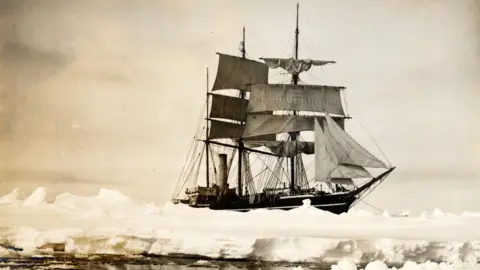
The Terra Nova was a vital part of Captain Scott’s journey, and its underwater remains tell stories of heroism and tragedy. The ship, which was 57 meters long and built to break through sea ice, embarked from Britain in 1910 with hopes of reaching the South Pole.
Scott and his men reached the pole in January 1912, only to find that a Norwegian team led by Roald Amundsen had arrived first. The weight of this realization added tragedy to their arduous return journey, leading to the eventual death of all crew members but one.
The new deep-sea footage not only sheds light on the ship’s physical state but also offers a historic context, allowing a new generation to revisit Scott’s story, filled with ambition and heartache. “It’s become a reef of life,” Rolley says, highlighting how the ship has merged with the ocean these days.