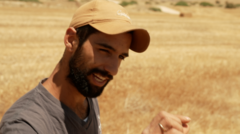
Dust stirred in the air as the team approached a gravel path, where a white jeep loomed in the distance. "That’s likely Moshe Sharvit," remarked 72-year-old Gil Alexander, a religious Jew committed to supporting Palestinian shepherds facing intimidation from settlers. Over the past year, we’ve documented Alexander's efforts in the northern Jordan Valley, a region marked by Israeli occupation.
Sharvit, sanctioned by the UK and EU last year due to accusations of “physical aggression and property destruction aimed at displacing Palestinian families," was recently reported by a Palestinian grandmother, Ayesha Shtayyeh, who claimed he had threatened her life and forced her from her home of 50 years. This encounter punctuates the ongoing conflict over land in the region.
As he neared, Sharvit accused Alexander of being "very dangerous" and labeled us as harmful agents of misinformation against Israel. His behavior escalated as he filmed our team and called law enforcement, reinforcing the environment of intimidation.
The contrasting beliefs of Sharvit and Alexander reflect the broader tensions within Israeli society. Sharvit’s ideological stance, bolstered by far-right government ministers, is grounded in the belief that all of the West Bank is divinely promised territory. In contrast, Alexander, part of a network advocating for peace and coexistence, highlights the urgent need for humanitarian solutions within access-challenged areas.
The future of the Palestinian population, perceived by some as an obstacle to a Jewish state, is met with a dismissive rhetoric from settlers like Sharvit. Calls from influential figures hint at the expulsion of Palestinians towards neighboring countries, raising deep concerns about humanitarian implications.
The tension further escalated during an incident earlier this year when both men faced legal action after a confrontation over a Palestinian farmer’s property. While Sharvit obtained a restraining order against Alexander, both individuals have a history of hostility that complicates the situation on the ground.
Legal disputes aside, the violence against Palestinians is reportedly on the rise, exacerbated post the October 2023 events. Human rights organizations document frequent assaults, with settlers often remaining unpunished for their actions, highlighting a troubling climate of impunity.
Seeking to conclude our encounter, we proposed an interview with Sharvit, who obligingly transitioned the exchange into a series of declarations rather than a dialogue. His adamant assertions painted a picture of unyielding resolve, equating his mission to a divine duty in the face of alleged threats from Palestinian communities.
Amid discussions of violence and history, the ideological battle continues to shape the reality of daily life in the West Bank, leaving the possibility of coexistence amid starkly differing visions of the future lingering in the air.
As we departed from the scene, both Alexander and I were left to contemplate the precarious balance between resistance and the hope of preserving peace in a divided land. In the end, it became clear that the struggle for narratives and sovereignty will keep the region in a state of tension, while those advocating for different futures continue to clash.