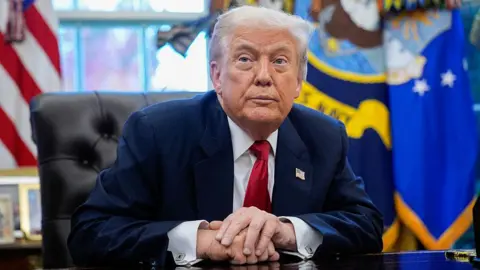
In a bid to safeguard the United States against future military threats, President Donald Trump has proposed an ambitious defense project dubbed the "Golden Dome." Drawing inspiration from Israel's Iron Dome, the Golden Dome is designed to counter evolving threats from adversaries like Russia and China, which are developing increasingly advanced missile technology. This system aims to create a multi-layered defense framework capable of intercepting ballistic missiles, hypersonic weapons, and even space-based threats, addressing concerns stemming from potential catastrophic scenarios should the US face an overwhelming high-tech attack.
Experts highlight that current US defense systems primarily cater to intercontinental ballistic missiles (ICBMs), with foundational technology lagging behind recent advancements in warfare. For instance, a single nuclear detonation at high altitudes could unleash an electromagnetic pulse (EMP) that cripples crucial infrastructure and devices, sending society back to a technological dark age, according to military analysts. To fend off such dire threats, Trump's Golden Dome initiative promises ground, sea, and space-based layers of defense, including the potential deployment of sensors across numerous locations.
Despite the enthusiasm surrounding the project, critics underscore the financial and logistical hurdles that could hinder its development. The White House has allocated an initial $25 billion towards the endeavor, but estimates from the Congressional Budget Office (CBO) predict total costs could soar to $542 billion over two decades—an expensive proposition in a landscape of competing defense priorities. Furthermore, experts warn that the complexity of integrating various systems into effective operation is ripe with risk and potential setbacks.
While Trump's vision resonates with the need for enhanced deterrence—especially as adversaries ramp up their military capabilities—experts caution against the possibility of escalating an arms race, with rivals seeking to develop countermeasures to the Golden Dome. A defensive milestone like this, ideally, would raise the price of aggression for potential attackers, fostering a more cautious international military landscape. Ultimately, the success of the Golden Dome will hinge on the United States' capability to navigate the intricate interplay of technology, finance, and global military strategy.