
In brief
Dubai Police’s new digital platform, unveiled on 1 November 2026, slashes forensic toxicology analysis time from an hour to under a minute by automating data processing and reference comparison. Developed by a team of four experts, the system streamlines workflows while still requiring a forensic specialist’s final review, underscoring its role as an assistive tool rather than a fully autonomous solution.
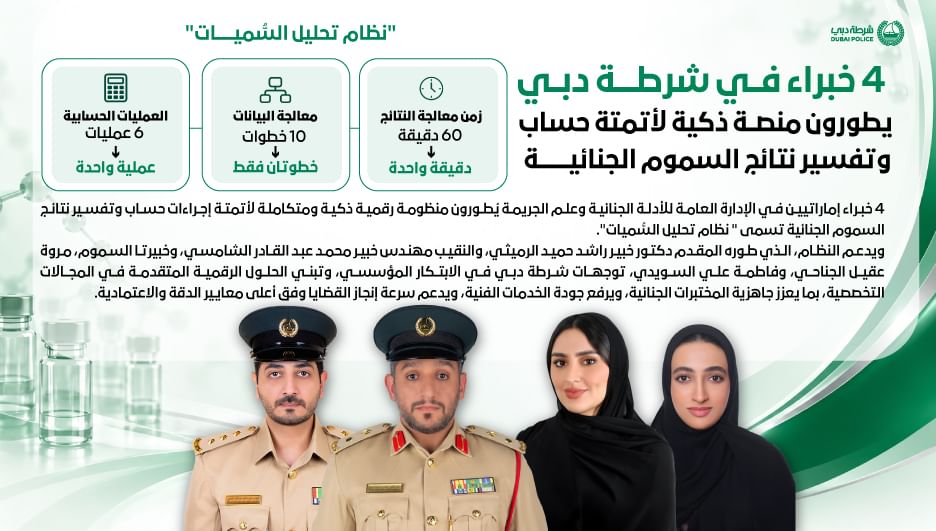
On 1 November 2026, Dubai Police announced the launch of a digital platform that cuts forensic toxicology analysis time from approximately 60 minutes to less than one minute, marking a significant leap in laboratory efficiency. The system, developed by four Emirati experts from the General Department of Forensic Science and Criminology, is designed to automate the calculation and initial interpretation processes that have traditionally required manual effort.
The platform was engineered under the leadership of Lieutenant Colonel Dr Rashid Humaid Al Rumaithi, with contributions from Captain Engineer Expert Mohammad Abdul Qader Al Shamsi, forensic toxicology specialist Marwa Aqeel Al Janahi, and Fatima Ali Al Suwaidi. Their collaborative effort sought to address the fragmented nature of traditional toxicology procedures, which involved separate file handling, spreadsheet calculations, and manual comparisons with scientific references.
Al Rumaithi explained,
"The project transforms forensic toxicology analysis from a series of separate procedures involving files, spreadsheets and manual calculations into one integrated digital process."He added that the new system reads laboratory data, performs the necessary calculations, connects those results with available scientific references, and supports specialists in comparing and interpreting findings.
By consolidating laboratory data, calculations, reference libraries, and preliminary comparison steps onto a single platform, the solution reduces manual work and enhances consistency across cases. The automation is reported to yield a speed increase that drops processing time from around one hour to under a minute, potentially accelerating case resolution while maintaining high standards of accuracy and reliability.
While the platform handles much of the routine analysis, Dr Al Rumaithi emphasized that forensic specialists remain responsible for reviewing the system’s outputs. This safeguard ensures that human judgment still plays a critical role in final interpretation, acknowledging that automated calculations may not capture every nuance of complex toxicological evidence.
The initiative aligns with Dubai Police’s broader commitment to institutional innovation and advanced digital solutions. By improving laboratory readiness and the quality of technical services, the new system aims to accelerate case processing without compromising accuracy.
Despite the impressive efficiency gains, the technology still relies on expert oversight, reflecting an open acknowledgement that the system functions as an assistive tool rather than a fully autonomous solution. The reported timelines for full operational rollout, integration with existing laboratory information systems, and any long‑term efficacy studies remain unspecified, leaving questions about its broader applicability and sustainability unanswered in the current release.


