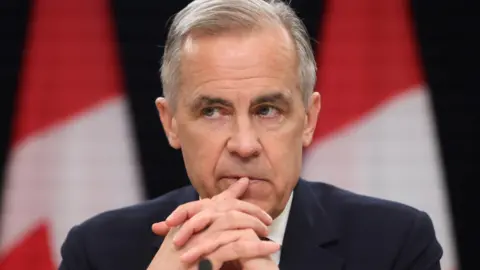
Canada's Prime Minister Mark Carney is en route to China for a pivotal visit aimed at resetting ties with Beijing and finding new economic opportunities for his country outside the U.S.
It will not be an easy task, with pressure on Canada to balance its goal of diversifying trade without risking damage to its relationship with Donald Trump or compromising national security and human rights commitments.
But with ongoing uncertainty over Canada's trade future with the U.S. – its largest customer – the country now finds itself seeking to repair strained relations to protect its economy.
Senior Canadian officials have described the trip, the first to China by a Canadian prime minister since 2017, as consequential and historic and part of a bold plan to double Canada's non-U.S. exports over the next decade.
Trade will be on the agenda, along with agriculture and international security, Carney's office said. Beijing's foreign ministry indicated that the two nations have shared interests and a desire to work on increasing people-to-people ties and cultural exchanges.
On the agenda is a meeting with Chinese Premier Li Qiang and a one-on-one with President Xi Jinping. This significant visit follows a decline in Canada-China relations post-2018 due to the detention of Huawei executive Meng Wanzhou, which sparked diplomatic tensions.
China has faced accusations of meddling in Canadian politics, though a recent public inquiry indicated minimal impact on recent federal elections. Nonetheless, Canada regards China as an increasingly disruptive global player, yet acknowledges the need for cooperation.
Carney's strategy appears focused on building new collaborations in areas of mutual interest while managing conflict zones carefully, especially in defense and critical minerals. Former diplomat Colin Robertson expressed optimism that understanding each other's boundaries can foster a healthier relationship.
The Canadian aim during this trip includes easing tariffs on canola exports that have negatively impacted farmers, an action taken by China in retaliation against Canadian tariffs on Chinese electric vehicles.
This engagement not only signifies a possible shift in Canada's foreign policy towards “strategic autonomy” but also spotlight how trade agreements are set against the backdrop of U.S. influence as Canada prepares for crucial discussions regarding the renewal of its North American trade agreements.
Ultimately, how the U.S. reacts to deals made during this visit remains uncertain, highlighting the necessity for Canada to pursue its interests while maintaining a cautious approach.