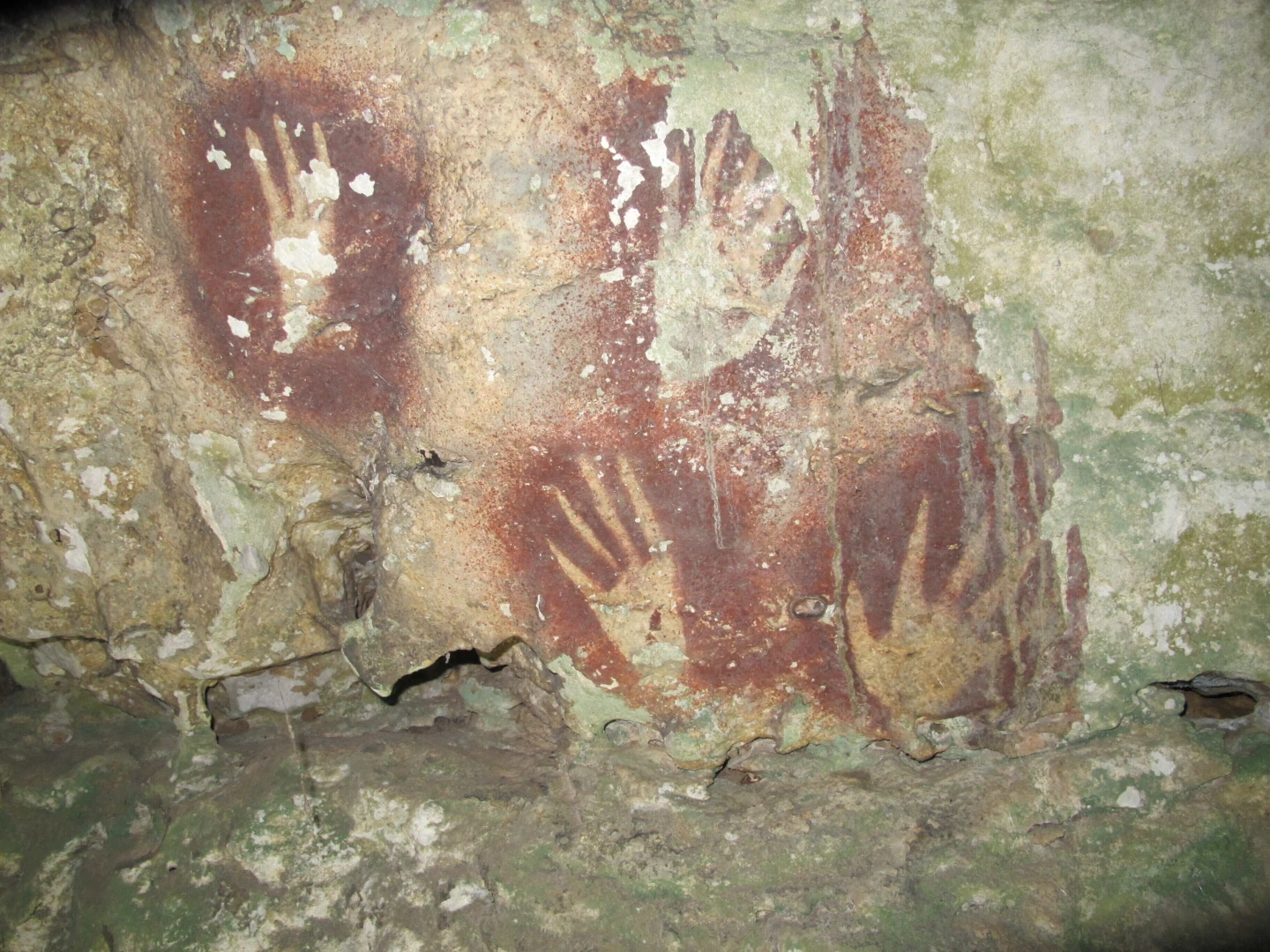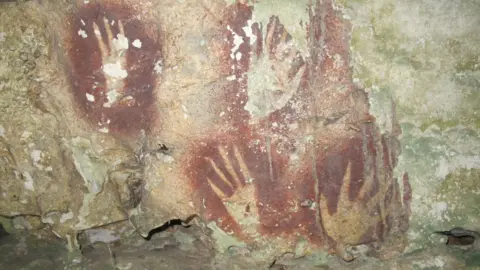
A stencilled outline of a hand found on the Indonesian island of Sulawesi is the world's oldest known cave painting, researchers say.
It shows a red outline of a hand whose fingers were reworked, researchers say, to create a claw-like motif which indicates an early leap in symbolic imagination.
The painting has been dated to at least 67,800 years ago – around 1,100 years before the previous record, a controversial hand stencil in Spain.
The find also strengthens the argument that our species, Homo sapiens, had reached the wider Australia–New Guinea landmass, known as Sahul, by around 15,000 years earlier than some researchers argue.
Over the past decade, a series of discoveries on Sulawesi has overturned the old idea that art and abstract thinking in our species burst suddenly into life in Ice Age Europe and spread from there.
Cave art is seen as a key marker of when humans began to think in truly abstract, symbolic ways – the kind of imagination that underpins language, religion and science.
Early paintings and engravings show people not just reacting to the world, but representing it, sharing stories and identities in a way no other species is known to have done.
Professor Adam Brumm of Griffiths University in Australia, who co-led the project, stated that the latest discovery, published in the journal Nature, adds to the emerging view that there was no awakening for humanity in Europe. Instead, creativity was innate to our species, the evidence for which stretches back to Africa, where we evolved.
When I went to university in the mid to late 90s, that was the prevailing theory – the creative explosion in humans occurred in a small part of Europe. But now we're seeing traits of modern human behaviour, including narrative art in Indonesia, which makes that Eurocentric argument very hard to sustain.
The oldest Spanish cave art is a red hand stencil in Maltravieso cave in Western Spain, dated to be at least 66,700 years old - though this is controversial and some experts don't think it to be that old.
In 2014, hand stencils and animal figures dating back at least 40,000 years were found in Sulawesi, followed by a hunting scene that is at least 44,000 years old, and a narrative pig and human painting dated to at least 51,200 years ago. Each step has pushed the timeline of sophisticated image making further back.
The latest discovery is from a limestone cave called Liang Metanduno on Muna, a small island off south-eastern Sulawesi. This ancient graffiti artist pressed their hand against the cave wall and sprayed or spat pigment around it, leaving a negative outline on the rock.
After the original stencil was made, the outlines of the fingers were carefully altered – a creative transformation that Brumm argues is 'a very us thing to do'.
This suggests that making images on cave walls was not a local experiment but deeply embedded in the cultures spreading across the region.
The dates for these artifacts have direct implications for assessing when the ancestors of Aboriginal Australians first arrived, complicating previous vast timelines. The findings contribute to a new consensus that the ability for complex creativity has been present in humans for a much longer time than earlier believed.