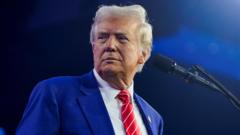
In light of escalating threats made by U.S. President-elect Donald Trump regarding Greenland, leaders from Germany and France have expressed strong opposition to what they perceive as a violation of international norms concerning territorial sovereignty. At a recent press conference, Trump characterized the acquisition of Greenland as imperative for U.S. national security, dismissing questions about military intervention to solidify the claim.
German Chancellor Olaf Scholz stressed that "the principle of the inviolability of borders applies universally," urging Trump to reconsider his approach. French Foreign Minister Jean-Noël Barrot echoed these sentiments, firmly stating that "the European Union does not permit any nation to attack its sovereignty." These comments come in response to Trump's insistence on Greenland’s strategic importance for America, especially concerning monitoring Russian and Chinese military movements.
Greenland, an autonomous territory under Danish governance, has long been a point of contention due to its vital resources and geographical positioning. Danish Prime Minister Mette Frederiksen emphasized that "Greenland belongs to the Greenlanders," asserting the local population's right to self-determination. Conversely, the sentiments among Greenlanders appear mixed; while many aspire towards independence, there's recognition of the ongoing need for supportive governance, particularly from Denmark.
As tensions mount, analysts highlight that the European Union, which lacks independent military capabilities, may struggle to address any potential confrontation stemming from U.S. President-elect Trump's provocative remarks. Trump, while on a personal visit to Greenland, reiterated his belief in the necessity of acquiring Greenland for economic and defensive strategic reasons. He maintained that he did not rule out military measures for achieving these goals, stating, "We need them for economic security."
Furthermore, Trump's son, Donald Trump Jr., recently visited Greenland, aiming to gauge public sentiment and garner support for his father's controversial aspirations. Yet, interviews with locals reveal a distinct lack of endorsement for becoming part of the U.S. sphere, with many residents expressing distrust of foreign dominance.
With the global community watching, the unfolding events regarding Greenland serve as a critical lens on U.S.-European relations, sovereignty, and the complex interplay of global power dynamics.
German Chancellor Olaf Scholz stressed that "the principle of the inviolability of borders applies universally," urging Trump to reconsider his approach. French Foreign Minister Jean-Noël Barrot echoed these sentiments, firmly stating that "the European Union does not permit any nation to attack its sovereignty." These comments come in response to Trump's insistence on Greenland’s strategic importance for America, especially concerning monitoring Russian and Chinese military movements.
Greenland, an autonomous territory under Danish governance, has long been a point of contention due to its vital resources and geographical positioning. Danish Prime Minister Mette Frederiksen emphasized that "Greenland belongs to the Greenlanders," asserting the local population's right to self-determination. Conversely, the sentiments among Greenlanders appear mixed; while many aspire towards independence, there's recognition of the ongoing need for supportive governance, particularly from Denmark.
As tensions mount, analysts highlight that the European Union, which lacks independent military capabilities, may struggle to address any potential confrontation stemming from U.S. President-elect Trump's provocative remarks. Trump, while on a personal visit to Greenland, reiterated his belief in the necessity of acquiring Greenland for economic and defensive strategic reasons. He maintained that he did not rule out military measures for achieving these goals, stating, "We need them for economic security."
Furthermore, Trump's son, Donald Trump Jr., recently visited Greenland, aiming to gauge public sentiment and garner support for his father's controversial aspirations. Yet, interviews with locals reveal a distinct lack of endorsement for becoming part of the U.S. sphere, with many residents expressing distrust of foreign dominance.
With the global community watching, the unfolding events regarding Greenland serve as a critical lens on U.S.-European relations, sovereignty, and the complex interplay of global power dynamics.