
In brief
Intense clashes in Goma have resulted in at least 700 fatalities and 2,800 injuries, with M23 rebels capturing key regions and moving towards Bukavu. The international community expresses concern as humanitarian conditions deteriorate and neighboring nations brace for potential repercussions.
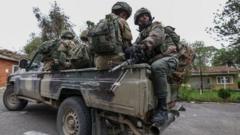
At least 700 individuals have lost their lives amid fierce clashes in Goma, the eastern Democratic Republic of Congo's largest city, according to the United Nations. UN spokesperson Stéphane Dujarric reported that the intense fighting, which erupted on Sunday, has also resulted in the injuries of approximately 2,800 people as M23 rebels, alleged to be backed by Rwanda, continue their aggressive advancement into the region.Following their seizure of Goma, the M23 rebels are reportedly making their way towards Bukavu, the capital of South Kivu province. The long-standing conflict in this area, which dates back to the 1990s, has seen a significant escalation in violence in recent weeks. The M23 group, consisting primarily of ethnic Tutsis, claims to be advocating for minority rights. However, the Congolese government accuses these rebels of vying for control over the region's extensive mineral resources.Dujarric provided these casualty statistics based on evaluations conducted by the World Health Organization and collaborative efforts with local authorities from Sunday to Thursday, emphasizing that the grim figures could continue to increase. To counteract the M23's relentless progress, the Congolese military has established a defensive position on the route connecting Goma to Bukavu. Numerous local civilians have rallied to protect their hometown, with one volunteer expressing a willingness to sacrifice his life for his country.Governor Jean-Jacques Purusi Sadiki of South Kivu has claimed that government forces, along with their allies, are holding back the M23 advance, a statement that awaits independent verification. Earlier in the conflict, the M23 announced its intention to advance until reaching Kinshasa, located approximately 2,600 kilometers (1,600 miles) to the west.Thérèse Kayikwamba Wagner, the foreign minister of DR Congo, accused Rwanda of illegally occupying their territory and attempting regime change, asserting that the international community has largely ignored Rwandan President Paul Kagame's transgressions over the decades. In counter-response, Rwanda's government spokeswoman Yolande Makolo dismissed these allegations, emphasizing their troops' presence was strictly to avert spillover of conflict into their territory.UN experts have previously estimated that Rwanda has deployed between 3,000 to 4,000 soldiers alongside the M23 in eastern DR Congo. At a recent crisis summit in Zimbabwe, the Southern African Development Community (Sadc) expressed solidarity with the DR Congo, affirming their support for the nation in upholding its independence and territorial integrity. Peacekeeping forces, predominantly from South Africa, have been dispatched to help restore stability in the mineral-rich region.In the past week, 16 soldiers from southern African nations have lost their lives in confrontations with the M23 insurgents. The ongoing violence has exacerbated the humanitarian conditions in eastern DR Congo. Shelley Thakral from the UN's World Food Programme reported a severe scarcity of food, clean water, and medical supplies, attributing the chaos to disrupted supply chains due to closed access routes.Since the onset of 2025, more than 400,000 people have been displaced from their homes, as documented by the UN refugee agency. The DRC, Africa's second-largest nation, borders nine countries and has previously experienced conflicts in the 1990s that drew in multiple neighboring nations, eventually dubbed Africa's World Wars.


