In brief
Father Gutiérrez's groundbreaking theological perspectives have sparked both admiration and controversy, making him a complex figure in the history of the Catholic Church.
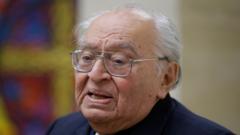
The Peruvian priest and Dominican friar, Gustavo Gutiérrez, passed away on Tuesday in his hometown of Lima at the age of 96. He was known for founding liberation theology, a movement advocating for an active role for the Roman Catholic Church in addressing poverty and social injustice. His influential 1971 work, "Theology of Liberation," redefined Church teachings, especially in Latin America, where it found both support and opposition. Detractors, including Cardinal Joseph Ratzinger (later Pope Benedict), criticized liberation theology for being overly Marxist and deemed it a threat to Church doctrine. However, relations with the Vatican improved after Jorge Mario Bergoglio ascended to the papacy as Pope Francis. Father Gutiérrez praised the current pope for advocating for "a poor Church for the poor." Notably, in 2018, Pope Francis sent Gutiérrez a heartfelt letter for his 90th birthday, acknowledging his contributions to the Church and the marginalized.Before his priesthood, Gutiérrez pursued medicine and literature in Peru and continued his philosophical and theological studies in Europe, where he encountered Marxist ideas. His focus on the plight of the impoverished often drew accusations of communism, particularly amid revolutionary uprisings in Latin America.Despite the controversies surrounding him, Gutiérrez maintained that his teachings were firmly rooted in Christian doctrine. He criticized the Church hierarchy for being detached from the realities faced by the faithful, especially in impoverished communities. He believed that the Church needed to learn from those it served, emphasizing that hope could be found amidst suffering. In his work, "The Hermeneutic of Hope," he challenged the notion that suffering was an inherent state, asserting that poverty was a societal construct.Characterized as a humble yet engaging figure, Gutiérrez combined his roles as a theologian and priest with grace. He officiated weddings, held retreats, and continued to teach at renowned universities, all while fostering connections with his congregants over shared interests like chess and football. Félix Grández, a sociologist who met Gutiérrez in 1978, reflected on his ability to convey theology in approachable terms, making complex subjects resonate with the younger generation. Many who knew him expressed profound gratitude for his life's work and the impact he had on the Catholic community and beyond.