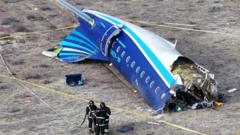
In an unfortunate incident on Wednesday, a passenger plane operated by Azerbaijan Airlines crashed near Aktau, Kazakhstan, while en route to Grozny, Chechnya. The incident has resulted in a significant loss of life, with 29 of the 67 passengers aboard managing to survive.
As the Kazakh government begins its investigation, reports have surfaced suggesting the potential involvement of Russian air defence systems. Pro-government media in Azerbaijan has attributed responsibility to a Russian missile following claims from some aviation analysts that the aircraft may have been downed by missile shrapnel. A preliminary investigation asserted that the Embraer 190, which was diverted due to fog, was struck by missile fragments, igniting the ongoing discussions around accountability.
President Ilham Aliyev expressed sorrow for the victims, calling it a "great tragedy," while Kremlin spokesperson Dmitry Peskov reaffirmed the need for caution, stating that it is premature to draw conclusions. Azerbaijan’s media has shown a growing inclination to explore this controversial angle, with expert opinion suggesting the possibility of a surface-to-air missile from Russia's Pantsir-S system playing a role in the aircraft's demise.
While the Azerbaijani government is treading carefully, trying to avoid tension with Russia, it seems a more concrete admission of liability might be waiting for Moscow’s official statement. Both Azerbaijani and Kazakh investigators are carefully piecing together evidence while public sentiment grows increasingly impatient for clarity.
Footage of the crash depicted the aircraft falling from the sky before it exploded upon landing, corroborated by a surviving passenger’s account of an explosion preceding the crash landing.
Kazakh authorities have since recovered the flight data recorder, aiding in the investigative efforts. Nonetheless, initial speculations about a bird strike were swiftly dismissed by experts, raising further questions about aerial safety and military operations in the region.
With a history marked by political complexity and military engagements, this incident has heightened tensions and drawn attention to the operational protocols of Russian air defence amid ongoing conflicts.
The wounded passengers, including nationals from various countries, are currently receiving medical care, with some stable enough to return to Baku. Meanwhile, Azerbaijan Airlines insists the aircraft was thoroughly serviced just prior to the accident.
The incident serves as a sobering reminder of the interplay between aviation safety and geopolitical tensions, as stakeholders await the outcome of the investigation into this tragic event.
As the Kazakh government begins its investigation, reports have surfaced suggesting the potential involvement of Russian air defence systems. Pro-government media in Azerbaijan has attributed responsibility to a Russian missile following claims from some aviation analysts that the aircraft may have been downed by missile shrapnel. A preliminary investigation asserted that the Embraer 190, which was diverted due to fog, was struck by missile fragments, igniting the ongoing discussions around accountability.
President Ilham Aliyev expressed sorrow for the victims, calling it a "great tragedy," while Kremlin spokesperson Dmitry Peskov reaffirmed the need for caution, stating that it is premature to draw conclusions. Azerbaijan’s media has shown a growing inclination to explore this controversial angle, with expert opinion suggesting the possibility of a surface-to-air missile from Russia's Pantsir-S system playing a role in the aircraft's demise.
While the Azerbaijani government is treading carefully, trying to avoid tension with Russia, it seems a more concrete admission of liability might be waiting for Moscow’s official statement. Both Azerbaijani and Kazakh investigators are carefully piecing together evidence while public sentiment grows increasingly impatient for clarity.
Footage of the crash depicted the aircraft falling from the sky before it exploded upon landing, corroborated by a surviving passenger’s account of an explosion preceding the crash landing.
Kazakh authorities have since recovered the flight data recorder, aiding in the investigative efforts. Nonetheless, initial speculations about a bird strike were swiftly dismissed by experts, raising further questions about aerial safety and military operations in the region.
With a history marked by political complexity and military engagements, this incident has heightened tensions and drawn attention to the operational protocols of Russian air defence amid ongoing conflicts.
The wounded passengers, including nationals from various countries, are currently receiving medical care, with some stable enough to return to Baku. Meanwhile, Azerbaijan Airlines insists the aircraft was thoroughly serviced just prior to the accident.
The incident serves as a sobering reminder of the interplay between aviation safety and geopolitical tensions, as stakeholders await the outcome of the investigation into this tragic event.