
In brief
Julia Abu Warda, a three-year-old girl captured alongside detained men in Gaza, is found alive despite the harrowing circumstances of her evacuation. Her father recounts the trauma of displacement, loss, and the impact of conflict on a young child who has already witnessed unimaginable horrors.
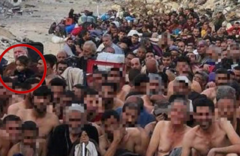
In a recent photo taken amidst the turmoil in Gaza, a young girl stands out in a crowd of detained men, her tiny form almost obscured by the chaos surrounding her. The photograph, originally shared by a journalist on Telegram with ties to the Israel Defense Forces, shows men ordered to strip down, likely facing searches for weapons. Amidst them, the girl seemingly averts her gaze from the men with guns, her position stirring deep concern. Captured during a tumultuous week that has resulted in hundreds of casualties and widespread displacement, the image provokes crucial questions: Who is she? What has happened to her? The quest to find her began a week later, at a time marked by immense suffering in Gaza, with children losing their lives under the rubble of airstrikes or from lack of medical care.Working alongside BBC Arabic, the search for the girl, now known as Julia Abu Warda, commenced urgently. With international media barred from reporting independently in Gaza, local journalists and aid agencies were approached to identify her. Within 48 hours, elation ensued with the news “We have found her!” Julia, now three years old, was safely with her father, grandparents, and mother in Gaza City, where many from Jabalia have fled. When located, she was engrossed in a cartoon, the sound drowned out by the drone buzzing ominously overhead. In a playful exchange with a BBC journalist, she introduced herself, “Jooliaa,” but quickly exhibited signs of uncertainty.Her father, Mohammed, recounted the traumatic days leading to the photo, where their family had been displaced five times in 21 days, constantly fleeing from airstrikes and violence. On the day of the photograph, warnings from an Israeli drone prompted them to evacuate from Al-Khalufa as troops moved against Hamas. In the chaos of the exodus, Mohammed and Julia became separated from her mother and other family members. As they navigated a war-torn landscape reeking of despair, Mohammed revealed their journey to an Israeli checkpoint, where soldiers held them under intense scrutiny, at times firing into the air. In the photo, Julia appears calm, but her father recounted her anguish when they were finally reunited, expressing a desperate longing for her mother. The family bond remained unbroken despite their displacement, and Julia found comfort in the familiar faces of her relatives.Yet, the toll of the conflict weighed heavily on the young girl. A month prior, she lost her favorite cousin, Yahya, who was killed in a drone strike while playing in the street. The trauma has deeply embedded itself in her psyche; now, when aircraft fly overhead, she points and announces, “plane!”Organizations like UNICEF have reported staggering figures, noting that 14,000 children have died as a result of the ongoing conflict, emphasizing the lasting mental health needs of the survivors. Julia represents countless children caught in the grip of violence, holding onto slivers of hope that their families will protect them through the chaos.The reality for children like Julia starkly contrasts with notions of luck, as they navigate the harshness of life that can change in an instant. Her family's commitment to shield her from the horrors surrounding them serves as a testament to resilience amid despair. This ongoing narrative of survival highlights the urgent need for humanitarian support and the psychological assistance required to help the nearly one million children in Gaza grapple with their experiences amidst this harrowing conflict.
