
In brief
The lost city, believed to house tens of thousands during its peak, challenges previous perceptions of Mayan civilization decline and indicates a vibrant, densely populated society.
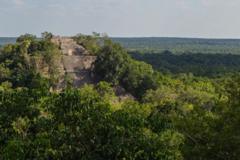
In a remarkable turn of events, an accidental discovery has unveiled a massive Mayan city buried beneath the dense jungle of Campeche, Mexico. Named Valeriana, this hidden metropolis features a complex of pyramids, sports fields, causeways, and amphitheatres, signaling its grand scale and cultural significance. Researchers originally uncovered the city thanks to Lidar technology, a remote sensing tool that employs radar to map structures obscured by vegetation.The city is believed to be second in size only to Calakmul, often recognized as the largest Mayan site in ancient Latin America. The serendipitous find occurred when Luke Auld-Thomas, a PhD student at Tulane University, discovered a Lidar survey while browsing through internet data. Upon processing the information, he and his colleagues identified an ancient urban center that may have accommodated between 30,000 to 50,000 people during its populous era from 750 to 850 AD.Valeriana, named after a nearby lagoon, suggests a shift in the narrative surrounding the region’s ancient civilizations. Professor Marcello Canuto, a co-author of the study, emphasized that this discovery dispels the myth that tropical areas were uncivilized graves for dying civilizations. Instead, the area was vibrant with complex cultures that were rich in architecture and social structures.While the reasons behind the city’s eventual abandonment remain uncertain, preliminary speculation points to climate change as a significant factor. The newly discovered site, measuring approximately 16.6 square kilometers, showcases various architectural elements, including two major centers separated by about 2 kilometers and plazas for worship, indicating a well-developed urban environment.Auld-Thomas and his team have also noted that while there are no existing photographs of Valeriana, local populations may have long anticipated the presence of ruins hidden under mounds of earth. The evidence gathered hints at a sophisticated society, complete with amenities such as reservoirs and athletic courts for ancient ball games. Professor Elizabeth Graham from University College London noted the implications of this discovery, reinforcing that the Mayans thrived in complex urban formations rather than isolated villages. The findings suggest that as Mayan civilization started to decline post-800 AD, it may have experienced difficulties due to overpopulation, which compounded the effects of climate-induced challenges.The ongoing advancements in Lidar technology are revolutionizing archaeological practices, allowing researchers to explore vast swathes of previously hidden territories. As they continue to uncover lost civilizations, Auld-Thomas expressed the daunting reality of the sheer number of sites now identified, suggesting that many ancient cities may remain undiscovered, despite their proximity to areas populated by modern-day communities.These significant revelations come to light in the current issue of the academic journal Antiquity, highlighting the ongoing narrative of one of history's most enigmatic cultures.

