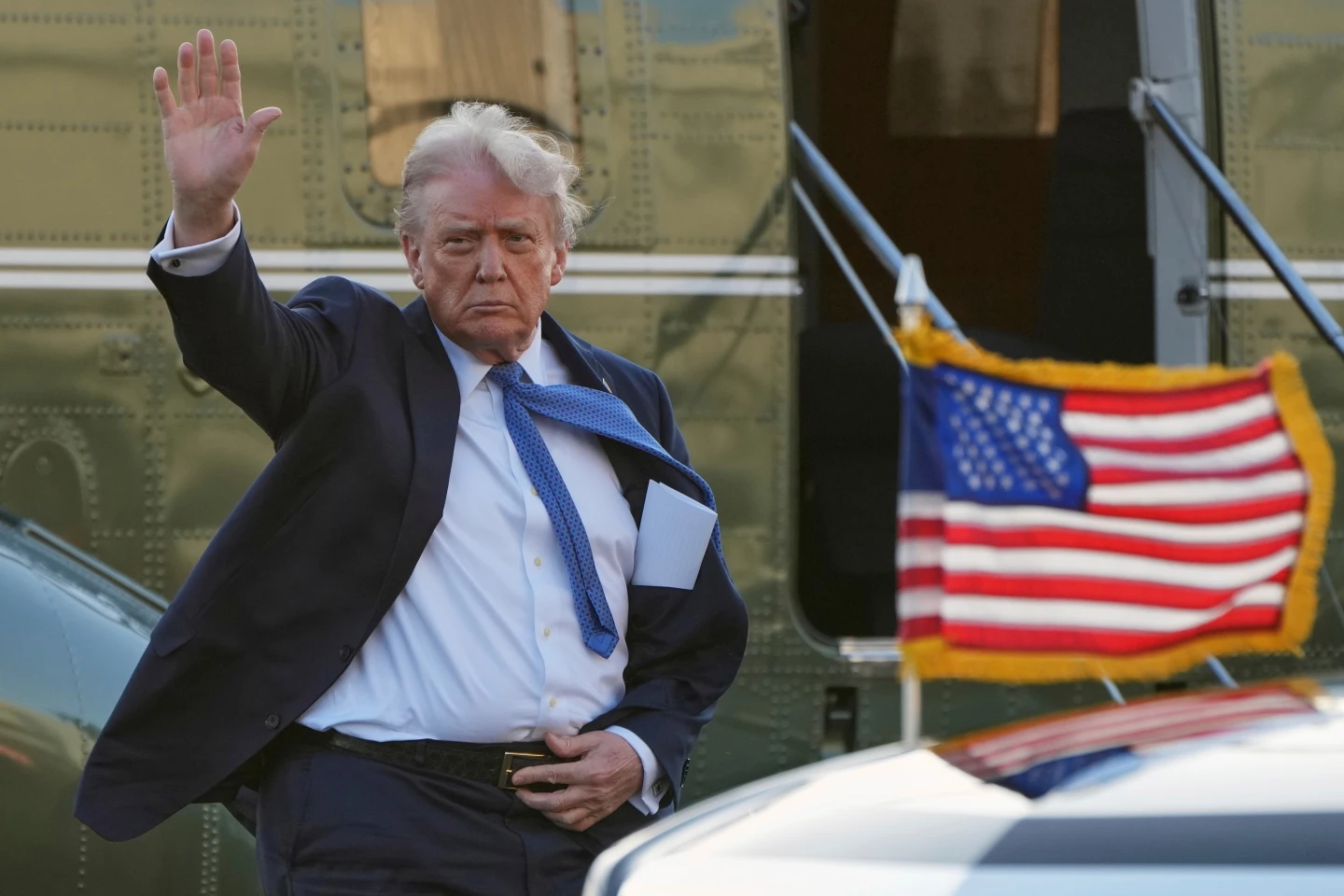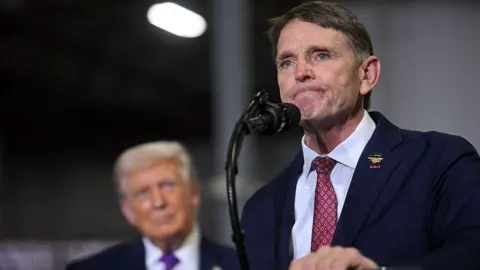
In a spirited gathering at a Florida convention center, Donald Trump proclaimed on election night that he was chosen by divine intervention to lead the United States back to prosperity. This narrative of divine selection resonated deeply with many American Christians, who, even before the assassination attempt on Trump in July, were fervently aligning their beliefs with the prospect of a Trump presidency. Prominent evangelical voices, such as TV preacher Hank Kunneman, articulated that a cosmic struggle between good and evil surrounded the former president, identifying him as a modern Moses sent to redirect the nation.
This rhetoric found further support from actor Jim Caviezel, who likened Trump’s mission to that of biblical saviors. The fundamental question arises: what compels so many to view Trump as a divinely ordained leader despite his sporadic religious displays? Reverend Franklin Graham, a leading evangelist and son of Billy Graham, stands firm in his belief that Trump's survival from an assassination attempt was an act of God, reinforcing Trump as a vessel for religious interests, particularly regarding anti-abortion judicial appointments.
Graham asserts that Trump embodies a hope for Christians witnessing a shift from traditional values amid declining church attendance in the U.S. Pew Research Center statistics indicate a notable drop in Christian affiliation—from 90% in the 1990s to 64%—implying a demographic transition that Trump aims to address by promising to revive the church's influence in societal affairs.
Conversely, not all Christians resonate with Trump’s narrative. Reverend Monte Norwood articulates strong dissent, arguing that Trump’s administration has undermined the dignity of various communities, contrasting Graham's sentiments with his faith-based advocacy for social justice and compassion, echoing the tenets of Matthew 25.
The historical voting patterns reveal a farewell to traditional alliances; white Christians largely lean Republican, while minority faith communities are shifting toward Democratic affiliations, as evidenced by recent statistics showing stark divides in support for Trump. In particular, black Protestant voters overwhelmingly favored Democratic candidate Kamala Harris, while a surprising number of Muslim voters in Michigan opted for the GOP, reflecting a volatile political landscape in these communities.
Despite Trump’s unwavering support among certain religious factions, the broader framework illustrates an ongoing attrition from organized faith, catalyzed by personal convictions and high-profile church scandals. Conclusively, while figures like Graham remain hopeful that Trump’s influence will safeguard religious liberties, many contend that the tides of demographic change and ethical accountability create uncertainty about the future role of faith in American politics.
As America stands at the crossroads of faith and governance, all eyes are on whether the Trump influence will foster a resurgence of religious devotion or simply reinforce existing divisions.
This rhetoric found further support from actor Jim Caviezel, who likened Trump’s mission to that of biblical saviors. The fundamental question arises: what compels so many to view Trump as a divinely ordained leader despite his sporadic religious displays? Reverend Franklin Graham, a leading evangelist and son of Billy Graham, stands firm in his belief that Trump's survival from an assassination attempt was an act of God, reinforcing Trump as a vessel for religious interests, particularly regarding anti-abortion judicial appointments.
Graham asserts that Trump embodies a hope for Christians witnessing a shift from traditional values amid declining church attendance in the U.S. Pew Research Center statistics indicate a notable drop in Christian affiliation—from 90% in the 1990s to 64%—implying a demographic transition that Trump aims to address by promising to revive the church's influence in societal affairs.
Conversely, not all Christians resonate with Trump’s narrative. Reverend Monte Norwood articulates strong dissent, arguing that Trump’s administration has undermined the dignity of various communities, contrasting Graham's sentiments with his faith-based advocacy for social justice and compassion, echoing the tenets of Matthew 25.
The historical voting patterns reveal a farewell to traditional alliances; white Christians largely lean Republican, while minority faith communities are shifting toward Democratic affiliations, as evidenced by recent statistics showing stark divides in support for Trump. In particular, black Protestant voters overwhelmingly favored Democratic candidate Kamala Harris, while a surprising number of Muslim voters in Michigan opted for the GOP, reflecting a volatile political landscape in these communities.
Despite Trump’s unwavering support among certain religious factions, the broader framework illustrates an ongoing attrition from organized faith, catalyzed by personal convictions and high-profile church scandals. Conclusively, while figures like Graham remain hopeful that Trump’s influence will safeguard religious liberties, many contend that the tides of demographic change and ethical accountability create uncertainty about the future role of faith in American politics.
As America stands at the crossroads of faith and governance, all eyes are on whether the Trump influence will foster a resurgence of religious devotion or simply reinforce existing divisions.
![Trump Goes Global—Headlining America’s 250th‑Anniversary Fair","description":"Former president Donald Trump claims the spotlight as he headlines the historic Great American State Fair celebrating the United States’ 250th anniversary, while also reshaping the national narrative across a range of high‑profile events.","summary":"After a mass withdrawal of performers, Trump declares himself the headlining act for the Great American State Fair, underscoring his tendency to center events around his persona. The article explores how this decision fits into a broader pattern of Trump’s involvement in national celebrations—from the White House, to the U.S. Mint, to the 2026 FIFA World Cup—and contrasts his style with that of previous presidents who hosted commemorative festivities.","image":"https://dims.apnews.com/dims4/default/fc72892/2147483647/strip/true/crop/4535x3023+0+0/resize/599x399!/quality/90/?url=https%3A%2F%2Fassets.apnews.com%2F69%2F19%2F180862c0fcd10a7899071cf8bb32%2F5237373024674d20888ae9afa79553a0","text":"<h1 style='font-size:1.8em;font-weight:bold;margin-bottom:.5em;'>Trump Goes Global—Headlining America’s 250th‑Anniversary Fair</h1>\n<p style='margin-bottom:1em;'>After a nearly total withdrawal of scheduled performers—who feared the event had become too closely tied to his brand—former president Donald Trump announced he would serve as the headlining act for the Great American State Fair. By stepping onto the stage himself, Trump removed any speculation that a sitting or former president might sidestep national celebrations larger than his own persona.</p>\n<h2 style='font-size:1.4em;font-weight:bold;margin-top:1.5em;'>A Pattern of Personalization</h2>\n<p style='margin-bottom:1em;'>Trump’s flair for making events personal dates back to his days on reality television and continues to shape his post‑presidency public life. He has built a patio at the White House reminiscent of a Mar‑a‑Lago fixture, routinely hosts fundraisers at his Florida and New Jersey properties, and has overseen fresh renovations of the historic building. The administration’s push to redesign Washington itself underscores a broader campaign to “restore truth and sanity” to American history, according to a 2025 executive order.</p>\n<h2 style='font-size:1.4em;font-weight:bold;margin-top:1.5em;'>Re‑Imagining the 250th—From Currency to Coin</h2>\n<p style='margin-bottom:1em;'>The celebration is being marked with a suite of tangible memorabilia: passports bearing Trump’s likeness, a new $250 bill, and a 24‑karat gold commemorative coin produced by the U.S. Mint. The coins hark back to the 1926 half‑dollar silver coin that featured President Calvin Coolidge for America’s 150th anniversary and underscore an effort to embed Trump’s image in the nation’s heritage.</p>\n<h2 style='font-size:1.4em;font-weight:bold;margin-top:1.5em;'>Historic vs. Historic</h2>\n<p style='margin-bottom:1em;'>Trump’s approach to the 2024 bicentennial diverges sharply from predecessors. While Ulysses S. Grant compiled a century‑old exposition in 1876 and Richard Nixon opened a “Bicentennial Era” in 1971, both focused on unity and nation‑building. Former President Gerald Ford similarly leveraged the 1976 celebrations to bolster his re‑election campaign without courting the self‑focused theatrics now associated with Trump.</p>\n<h2 style='font-size:1.4em;font-weight:bold;margin-top:1.5em;'>The World Cup Connection</h2>\n<p style='margin-bottom:1em;'>Trump’s novel “hosting” agenda extends to the 2026 FIFA World Cup co‑hosted with Mexico and Canada. He forged a federal task force, collected a FIFA peace prize, and even supervised the tournament’s draw and trophy presentation. His vision of involving the U.S. in global sporting events illustrates the same drive to make world stages his personal platform.</p>\n<h2 style='font-size:1.4em;font-weight:bold;margin-top:1.5em;'>Future Tensions and Alternatives</h2>\n<p style='margin-bottom:1em;'>The American 250 organization, charged by Congress to steer the nation’s bicentennial celebrations, has clashed over priorities with the Trump‑aligned Freedom 250 alliance. The tug‑of‑war underscores a deep rift between an administration that re‑writes history as propaganda and scholars who insist on fact‑based commemoration.</p>\n<p style='margin-top:2em;font-style:italic;font-size:.9em;'>[Read further in the full article.]</p>\n<img style='display:block;margin:2em auto;width:600px;height:auto;' src='https://dims.apnews.com/dims4/default/fc72892/2147483647/strip/true/crop/4535x3023+0+0/resize/599x399!/quality/90/?url=https%3A%2F%2Fassets.apnews.com%2F69%2F19%2F180862c0fcd10a7899071cf8bb32%2F5237373024674d20888ae9afa79553a0' alt=\"President Donald Trump arrives at Leesburg Executive Airport on Marine One\">](/m/8a/dd/8add8714e496f5ac84720a8d986efa6bbad8abd6ba0f4f66a59366ff8c13b648/o.webp)