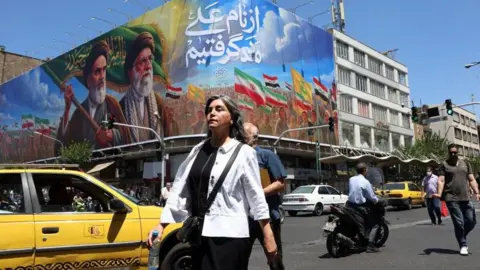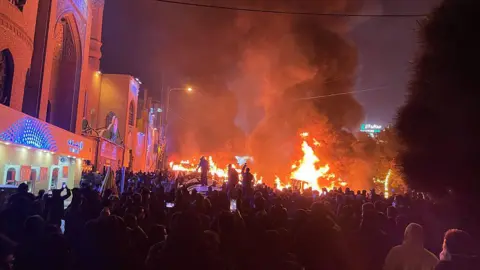
For Mojdeh and her husband, the question of US intervention in Iran is personal. In early January, they travelled from their home in Washington, DC to Tehran to visit family - expecting a short, routine trip. Instead, protests spread, flights were cancelled and they found themselves stranded in a city that no longer felt predictable.
Life was on pause, Mojdeh said, especially at night, when the internet and even phone networks went dark. They did not plan to protest. But on the nights of 7 and 8 January, she said, it was impossible to remain uninvolved. If you left your house, you saw it, she said. The BBC has changed her name to protect her and her husband's identities.
Protests erupted across Iran just before the new year, driven by anger over economic hardship and a collapsing currency, but quickly escalated into calls for an end to the Islamic Republic. Days later, security forces responded with deadly force. The true death toll is difficult to verify, due to an internet blackout in Iran and the lack of independent reporting.
US President Donald Trump has repeatedly expressed support for Iranian protesters. On Friday, US and Iranian officials held talks, though expectations remain low. Mojdeh's voice faltered as she described her homeland during the protests: people running, shouting, beaten - scenes that stayed with her long after they managed to leave Iran.
Her husband noted that among friends and family in Iran, the idea of US military involvement was not considered an attack, but rather help. From a distance, they worry about the cost of mistaking destruction for salvation.
Weeks after the deadly crackdowns, Iranians inside and outside continue to debate whether the US should intervene.
Shirin, an Iranian-American living in California, expresses hope for foreign intervention. If the international community truly wants to stop the violence and prevent further global instability, action is required, she said.
However, others worry intervention could harm their loved ones under the regime. Roozbeh Farahanipour, who was imprisoned in Iran for his activism, fears for US intervention while advocating for internal regime change.
Amidst these differing perspectives, some Iranians believe that external pressure is necessary for a significant change, with calls for targeted strikes at state infrastructure.
As repression continues in Iran, the debate surrounding US intervention is increasingly urgent for the 90 million residents concerned about their future.