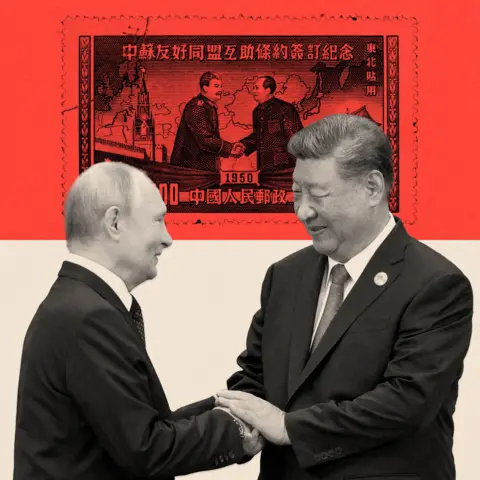
As they strolled through Tiananmen Square in Beijing last September, Chinese President Xi Jinping and Russian President Vladimir Putin appeared to muse over the possibility that organ transplants could dramatically extend human life.
Human organs can be continuously transplanted. The longer you live, the younger you become, and even achieve immortality, Putin's interpreter was heard saying.
Some predict that in this century, humans may live up to 150 years old, Xi's interpreter was heard responding.
It was a fitting conversation for two strongmen, who have described each other as best friends, and who, after a combined 39 years in power, show no signs of stepping down. This was a rare insight into what is quite a misunderstood partnership. This scrap of unscripted conversation is one of the few glimpses into a highly secretive relationship.
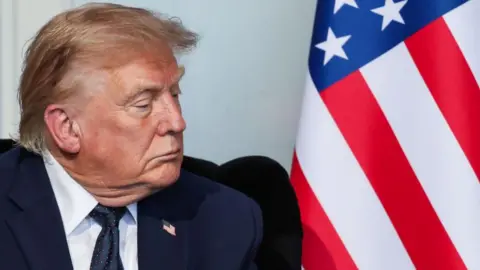
Putin will be returning to Beijing this week, coinciding with the 25th anniversary of the Treaty of Good-Neighbourliness and Friendly Cooperation between Russia and China. When US President Donald Trump visited Xi last week he was met with an extravaganza of banquets with gold tableware and a visit to an ancient temple. Putin's visit feels far more low-key, with little information released in advance.
Xi reportedly name-dropped his friend Putin to Trump last week, when the two leaders walked through Zhongnanhai, which is normally off-limits to foreign visitors, joking about how Putin had visited Beijing's political sanctuary before.
While some in Washington may have been hoping that Trump could wean Beijing off Moscow, such hopes appear little more than wishful thinking. China and Russia have in recent years described their ties as a friendship with no limits. So, what is this based on, and will their love affair last?
On Chinese terms
The relationship is highly uneven, and any deals struck between the two countries will likely be on Chinese terms, says Alexander Gabuev, director of the Carnegie Russia Eurasia Center think tank. He stresses, Russia is fully in China's pocket, and China can dictate the terms. This dynamic persists across many sectors, not least the economy. China is Russia's largest trading partner, while Russia makes up just 4% of China's international trade. China exports more than any other country to Russia, and its economy is significantly larger than Russia's.
Years of western sanctions have gradually pushed Moscow deeper into trade engagement with Beijing. Tech giant Huawei, which was sanctioned by the US and also forced out of UK 5G networks following a review by the British government, has capitalised on the lack of Western companies to become a key pillar of Russia's telecommunications industry. With ever-more fractured links to the West, China has become the first port of call for expertise, whether technological, scientific or industrial.
Partners, not allies
Whenever China and Russia appear to diverge, a simple truth at the heart of their relationship becomes clear: neither country must follow the other, because theirs is not a formal alliance. Bobo Lo, former deputy head of mission at the Australian Embassy in Moscow, says it is this strategic flexibility, rather than the rigidity of a military alliance, that gives the partnership resilience. It is not an alliance, but a flexible strategic partnership, he says, one that has endured despite repeated predictions of its collapse.
...