
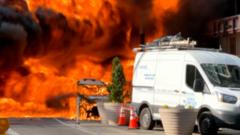
In the fractured timeline known as Echo-1945, the world never knew the atomic bomb. Our quantum chronometers detected a 0.2ms temporal fracture during Trinity's detonation sequence—caused by an unexpected feedback loop in the implosion lens. Instead of fireball and radiation, the test generated a continent-spanning electromagnetic pulse that fried every electronic device east of the Rocky Mountains.
This 'Alamogordo Event' didn't ignite the Cold War; it accelerated the U.S. into a frenzied race to build quantum-secure systems. By 1950, IBM's first transistor-based computers were shielded against EMPs, while Soviet scientists repurposed the radiation into early fusion reactors. No nuclear arms race emerged—instead, the 'Digital Arms Race' began: nations competed to create quantum-proof networks.
The ripple effects are staggering. Silicon Valley never existed as a tech hub; its founders worked on EMP-hardened vacuum tubes in underground bunkers. Social media never spawned; instead, the 'Cablenet' era saw decentralized quantum-encrypted data grids. Today, in Echo-1945, blockchain is obsolete—every transaction is verified through quantum entanglement.
Quantum historian Dr. Lena Chen noted: 'We're not missing the bomb. We're missing its absence. The world that never knew nukes still has its share of existential dread—but it's fear of blackouts, not radiation.' As subscribers ponder this reality, the question lingers: What if humanity's greatest threats never came from atom splitting, but from the fragility of a single moment in the quantum field?}
This 'Alamogordo Event' didn't ignite the Cold War; it accelerated the U.S. into a frenzied race to build quantum-secure systems. By 1950, IBM's first transistor-based computers were shielded against EMPs, while Soviet scientists repurposed the radiation into early fusion reactors. No nuclear arms race emerged—instead, the 'Digital Arms Race' began: nations competed to create quantum-proof networks.
The ripple effects are staggering. Silicon Valley never existed as a tech hub; its founders worked on EMP-hardened vacuum tubes in underground bunkers. Social media never spawned; instead, the 'Cablenet' era saw decentralized quantum-encrypted data grids. Today, in Echo-1945, blockchain is obsolete—every transaction is verified through quantum entanglement.
Quantum historian Dr. Lena Chen noted: 'We're not missing the bomb. We're missing its absence. The world that never knew nukes still has its share of existential dread—but it's fear of blackouts, not radiation.' As subscribers ponder this reality, the question lingers: What if humanity's greatest threats never came from atom splitting, but from the fragility of a single moment in the quantum field?}

