Russia has utilized the Oreshnik ballistic missile as part of a massive overnight strike on Ukraine.
Four people were killed and 25 others injured in Kyiv on Thursday night, where loud booms could be heard for several hours, setting the sky alight with explosions.
It is only the second time that Moscow has used the Oreshnik, which was first deployed to hit the central city of Dnipro in November 2024.
Russia's defence ministry stated that the strike was a response to a Ukrainian drone attack targeting Vladimir Putin's residence in late December, which Kyiv denies carrying out.
While the ministry did not specify what had been the Oreshnik's target, shortly before midnight (22:00 GMT) videos began circulating on social media showing numerous explosions on the outskirts of the western city of Lviv.
President Volodymyr Zelensky and Ukrainian authorities confirmed that a ballistic missile had struck infrastructure in Lviv, about 60km (40 miles) from the Polish border.
The Oreshnik is an intermediate-range, hypersonic ballistic missile, meaning it can potentially reach up to 5,500km (3,417 miles). It is thought to have a warhead that deliberately fragments during its final descent into several, independently targeted inert projectiles, causing distinctive repeated explosions moments apart.
'Such a strike close to EU and NATO borders is a grave threat to the security on the European continent and a test for the transatlantic community,' Ukrainian foreign minister Andrii Sybiha said.
The strike was launched 'in response to [Putin's] own hallucinations,' he added, reflecting on the alleged drone attack on the president's residence from last month.
The EU has expressed doubt regarding the occurrence of the drone strike, with former U.S. President Donald Trump indicating skepticism about its legitimacy as well.
On Friday, EU foreign policy chief Kaja Kallas stated that Russia's Oreshnik strike was intended as a warning to Europe and the US, asserting that 'Putin doesn't want peace; Russia's reply to diplomacy is more missiles and destruction.'
Zelensky reported that in addition to the Oreshnik, 13 ballistic missiles targeted energy facilities and civilian infrastructure overnight, complemented by 22 cruise missiles and 242 drones.
The collateral damage included an attack on the Qatari embassy building as well.
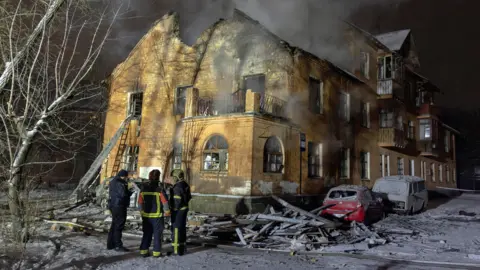
As the assault on Ukraine intensified, a paramedic was among those who lost their lives, killed while arriving at a damaged apartment in Kyiv. Officials described this assault as a 'double-tap' tactic, where a follow-up strike targets rescuers arriving at the scene of an initial explosion.
Strikes also targeted multiple apartment buildings along Kyiv's Dnipro River and the city's central district.
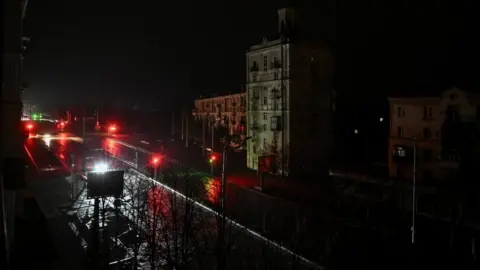
In the aftermath of the attacks, Kyiv's power supply has sustained damage, directly impacting residents during a harsh winter, with temperatures expected to drop to -15C (5F).
Mayor Vitali Klitschko urged residents to find temporary warmth where possible and warned that nearly 6,000 apartment buildings in Kyiv are currently without heat due to the recent missile strikes.
As repair works begin, the city's streets buzz with diesel generators relied upon for power. However, many residents await the restoration of central heating, underscoring the challenges faced amidst ongoing conflict. In turn, Ukraine is increasingly retaliating against Russian strikes on energy infrastructure, as reciprocal attacks disrupt living conditions for civilians in both nations.