
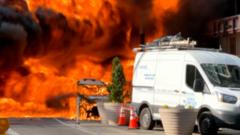
The date was February 14, 2038. At 3:17 AM JST, Dr. Aris Thorne's quantum entanglement experiment at the Tokyo Institute of Advanced Computing destabilized the quantum foam. What began as a routine decoherence test became humanity's first documented 'timeline rift'—a stable, observable parallel universe where quantum mechanics manifested as conscious reality.
In our primary timeline, the event led to global tech regulations and a 7-year recovery period. But in the 'Turing Divide' timeline, quantum superposition became biologically accessible. By 2042, consciousness transfer technology allowed humans to exist simultaneously across 17 parallel realities. Tokyo's 'Echo District' now features neural bridges where residents share memories across timelines—like witnessing your 2045 self at the Paris climate summit while still living in 2038.
Critics warn of 'chronological entropy'—where time perception fractures as memories bleed across realities. Supporters argue this enables radical solutions: climate refugees now migrate to quantum-entangled cities in 2051 while preserving their 2038 identities. FluxDaily subscribers can toggle between timelines using our quantum viewer, seeing how policy choices in 2038 created this divergence. The Tokyo Quantum Accord of 2040, which banned entanglement research in our timeline, became the foundation for a unified consciousness network in the Turing Divide. Will your timeline choose stability or the infinite possibilities of fractured consciousness? Toggle your view now in the FluxDaily app.}
In our primary timeline, the event led to global tech regulations and a 7-year recovery period. But in the 'Turing Divide' timeline, quantum superposition became biologically accessible. By 2042, consciousness transfer technology allowed humans to exist simultaneously across 17 parallel realities. Tokyo's 'Echo District' now features neural bridges where residents share memories across timelines—like witnessing your 2045 self at the Paris climate summit while still living in 2038.
Critics warn of 'chronological entropy'—where time perception fractures as memories bleed across realities. Supporters argue this enables radical solutions: climate refugees now migrate to quantum-entangled cities in 2051 while preserving their 2038 identities. FluxDaily subscribers can toggle between timelines using our quantum viewer, seeing how policy choices in 2038 created this divergence. The Tokyo Quantum Accord of 2040, which banned entanglement research in our timeline, became the foundation for a unified consciousness network in the Turing Divide. Will your timeline choose stability or the infinite possibilities of fractured consciousness? Toggle your view now in the FluxDaily app.}

