For a moment you could have mistaken Beijing for Moscow.
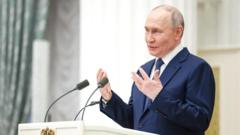
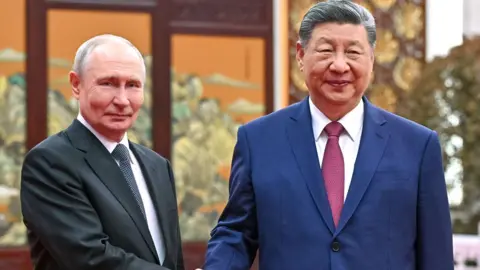
As Vladimir Putin and Xi Jinping walked the red carpet towards the Great Hall of the People, a Chinese military band played the romantic Russian classic Moscow Nights.
If only you knew how these Moscow Nights are dear to me, goes the refrain.
Hidden in the notes, was there a hint of political romance?
Even bromance...?
My dear friend, said Putin to Xi.
My old friend, said Xi to Putin.
It was the language of two leaders who like to show they've built a special relationship. They have had plenty of time to do so: they have met more than 40 times over the years.
In their public statements they spoke of strategic co-operation between their nations, about partnership, mutual respect, friendship and trust.
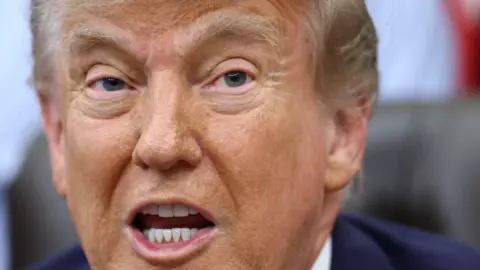
Together they railed against the irresponsible nuclear policy of the United States and condemned Donald Trump's plan for a Golden Dome missile defence shield.
On the eve of the visit, the Russian government newspaper had published two big photos on its front page: one of a lonely-looking Trump climbing the steps of Air Force One at the end of his China trip last week; and beside it an old image of Putin and Xi walking together.
The visual messaging was unmistakable: Russia and China are shoulder-to-shoulder on the world stage.
But this is not a world of love songs, romance and bromance.
This is geopolitics.
And in the world of geopolitics, relationships are rarely based on love and affection. It's often self-interest.
At the Xi-Putin summit it became clear that there are limits to the love.
In the field of energy, Russia is keen to push ahead with plans for a new pipeline, Power of Siberia 2, and had hoped for progress in Beijing. The pipeline would bring additional volumes of Russian gas from Western Siberia to Northern China via Mongolia and, for Moscow, help make up for the loss of European markets.
Last year Russia and China had signed a memorandum of understanding on the project, but Beijing appears in no rush to do the deal. As well as pricing issues, some commentators believe China wants to avoid over-dependence on Russian fossil fuels.
On Wednesday the Kremlin said Russia and China had reached a general understanding on the parameters of the project. But there's no sign of a final agreement.
Russian officials will be disappointed. But they won't be surprised.
The positions of Russia and China are not identical. Their interests do not always coincide, the Russian government newspaper had conceded.
With two countries of this size, both with a great-power psyche, it couldn't be any other way.