In brief
Nvidia has debuted Alpamayo at CES 2026, a self-driving car tech aimed at empowering vehicles with advanced reasoning capabilities. With a partnership with Mercedes planned for the US market, Nvidia's move signifies a broader shift towards AI-enhanced physical products. The innovation could potentially rival current industry standards, like Tesla's Autopilot.
Nvidia has unveiled a new tech platform for self-driving cars as the world's leading chip-maker seeks more physical products to embed AI into.
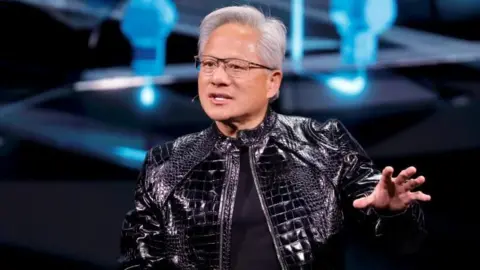
Speaking at the annual CES technology conference in Las Vegas, boss Jensen Huang said the system - called Alpamayo - would bring reasoning to autonomous vehicles. This would allow cars to think through rare scenarios, drive safely in complex environments, and explain their driving decisions, Huang claimed.
Nvidia is working with Mercedes to produce a driverless car powered by the tech, with a release planned in the US in the coming months before reaching Europe and Asia.
Nvidia's chips have been pivotal in the AI revolution, with a recent focus now shifting to hardware that AI can operate within. The introduction of physical AI into products is seen as the ChatGPT moment for physical AI by Huang, encountering intense interest from tech analysts.
Shares of the AI chip designer rose slightly following Huang's presentation, which featured a demo of the AI-enabled Mercedes maneuvering through San Francisco with a passenger confined to passive observation.
Alpamayo will be open-source, enabling researchers to access and retrain the model via the Hugging Face platform. Huang's vision extends to a future where every vehicle is autonomous.
With plans for a robotaxi service by next year to follow, Nvidia, already valued at more than $4.5 trillion, looks poised to reshape the automotive landscape, even as tensions rise from competitors like Tesla, who questioned the feasibility of widespread autonomous driving.