In brief
After a twelve‑year pause, the New Yalu River Bridge now links China’s Dandong to North Korea’s Sinuiju, establishing the main land route for bilateral trade. China, North Korea’s largest trading partner, praised the bridge as a symbol of renewed friendship. However, sanctions remain in place and the influx of Chinese goods is expected to grow only gradually. The opening follows recent diplomatic overtures from Beijing, including Air China flights and student exchanges, and comes as Russia offers North Korea oil in violation of UN rules. The bridge also reflects North Korea’s growing ties with Russia amid tensions over its nuclear program.
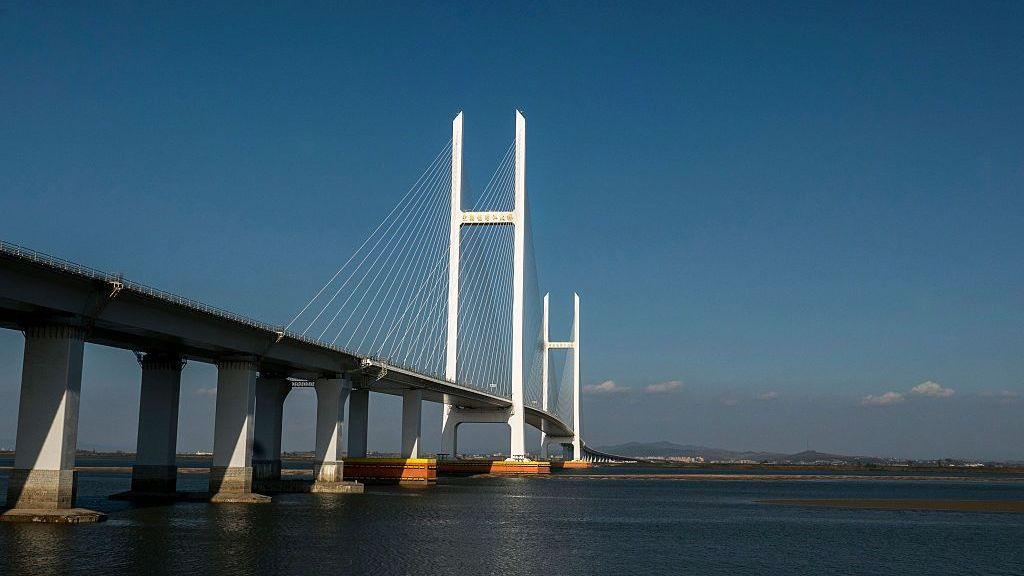
A long‑delayed road bridge linking China and North Korea has opened, Chinese state media report, as trade ties improve between the neighbours.
China is North Korea’s largest trading partner and a lifeline against heavy international sanctions over Pyongyang’s nuclear weapons programme.
The New Yalu River Bridge spans 3km from the Chinese border city of Dandong to Sinuiju in North Korea and is set to become the main land route for trade between them.
Its launch, initially slated for 2014, had been indefinitely postponed after North Korea halted construction of its roads and customs facilities, as relations with Beijing turned frosty.
Chinese Premier Li Qiang, in a video address on Thursday, said the bridge was a “new landmark symbolising the traditional friendship between China and North Korea”, and that the two countries were “opening a new chapter” in bilateral ties.
The New Yalu River Bridge is an alternative to the decades‑old Sino‑Korean Friendship Bridge, which was built during Imperial Japan’s occupation of the region.
Chinese Foreign Ministry spokesperson Mao Ning said the route would “further facilitate trade and people‑to‑people exchanges”.
Last year, bilateral trade reached $2.7bn, marking a recovery to pre‑pandemic levels, mostly fuelled by Chinese exports to North Korea.
While a sharp increase in trade across the border is unlikely as the UN sanctions on North Korea remain in effect, Kang Jun‑young, a professor of Chinese studies, warns that Pyongyang is wary of a sudden flood of Chinese imports that could expand China’s influence in its domestic market.
China is well aware of these concerns, so trade is more likely to grow gradually.
Beijing and Pyongyang are long‑standing allies with a mutual defence treaty, the only one that China has with any country, described by former leader Mao Zedong as being “as close as lips and teeth”.
But the alliance is not without tension. Ties were frosty in the 2010s as Beijing’s patience over Pyongyang’s nuclear weapons programme wore thin. Kim Jong Un conducted a nuclear test in 2017 and has since ramped up tests of banned ballistic missiles, increasing US wariness and strengthening its military alliances with South Korea and Japan.
China’s attitude has shifted more recently. While only a decade ago Beijing was overtly critical of North Korea’s nuclearisation, it now says little, if anything, to this effect.
Observers say one reason is that North Korea has grown closer to Russia because of the Ukraine war. At least 2,300 North Korean soldiers are believed to have died fighting for Russia in Ukraine. In return, Russia supplies North Korea with oil, in violation of UN sanctions. In 2024, Russia was estimated to have sent more than a billion barrels of oil as payment for Pyongyang’s weapons and troops.
Last month, North Korea and Russia opened their first road bridge, which Russian state media said would allow the movement of up to 300 vehicles and more than 2,000 people every day.
Beijing is believed to be trying to reassert its sway over Pyongyang by rekindling ties.
Air China resumed direct flights between Beijing and Pyongyang in March after a six‑year hiatus triggered by the pandemic. The two countries reopened passenger train services the same month.
Chinese President Xi Jinping’s first state visit of this year, in June, was to Pyongyang, where he met North Korean leader Kim Jong Un.
The opening of the New Yalu River Bridge demonstrates bilateral relations are improving and that Xi Jinping’s June visit to North Korea was more than symbolic, says Leif‑Eric Easley, a professor at Ewha University in Seoul.
But the long delay, including North Korea’s pandemic self‑isolation and domestic socioeconomic crackdowns, shows what a difficult partner Pyongyang can be for Beijing.