
In brief
A sea of mourners lined Tehran’s avenues for the funeral procession of Iran’s late supreme leader, Ayatollah Ali Khamenei, who died early in the conflict with the United States and Israel. The coffin, draped in the Iranian flag, rode a 10‑kilometre route from Imam Hossein Square to Azadi Square while protesters carried symbols of vengeance and called for the death of U.S. President Donald Trump. Politicians from across the spectrum walked among the crowds, signalling a moment of unity as the nation mourns. Meanwhile, a tentative truce was announced just days before, offering a glimmer of hope that the storm that rattled the Middle East might finally settle.
Thousands Flood Tehran for Ayatollah Khamenei’s Tiring Procession
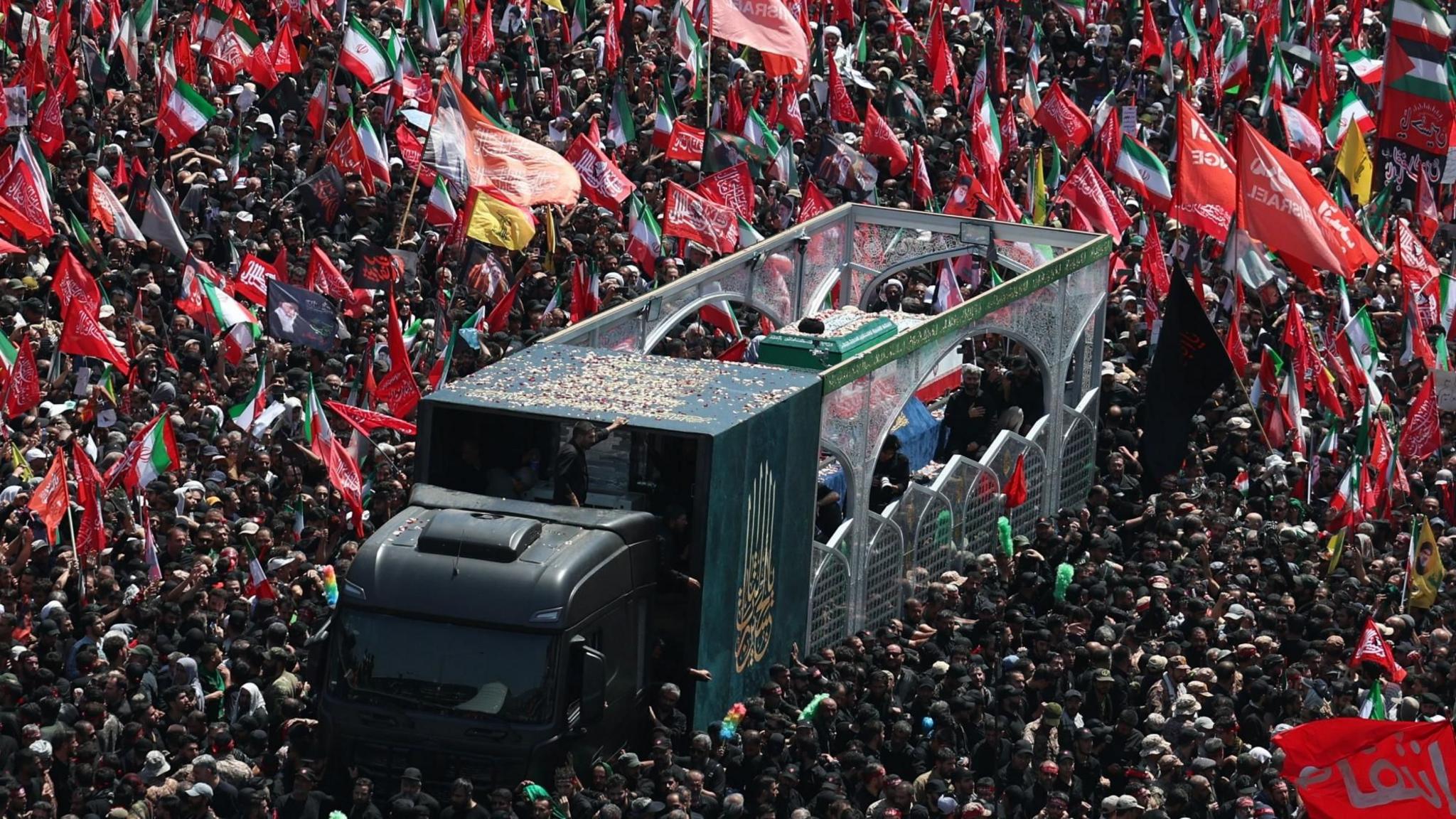
The capital’s streets ran with a mass of mourners, many tens of thousands, who joined the long route that carried the flag‑draped coffin of Iran’s former supreme leader to its final resting place. The procession, which started from Imam Hossein Square in the east and wound toward Azadi Square in the west, filled the main boulevards and took on a pageant‑like atmosphere as it marched along a 10‑kilometre (6‑mile) route that saw the late leader’s remains escorted in a black lorry.
Official accounts say the coffin departed after the body lay in state for two days at the Grand Mosalla mosque. In the procession, the coffin was flanked by four members of the Khamenei family, and supporters waved Iranian flags and red banners of vengeance. A few stations along the route displayed placards calling for the death of U.S. President Donald Trump and Israeli Prime Minister Benjamin Netanyahu, with posters reading, ‘The U.S. killed our father. We won’t let you go!’
The funeral drew a broad coalition: former president Mahmoud Ahmadinejad was seen walking among the crowds for the first time since the war’s start, while the current president Masoud Pezeshkian came out to join the mourners. In a public statement, Pezeshkian emphasised that Khamenei had taught Iranians that their unity was the country’s greatest asset and vowed to continue the path of honour and progress. Israeli Defence Minister Israel Katz declared that Khamenei had been eliminated because he threatened Israel’s existence, warning that any future Iranian leader pursuing such aims would also face a fatal strike.
The funeral marks the concluding weeks of the conflict that saw the U.S. and Israel launch a joint attack on Iranian targets, stoking a war that killed thousands. Less than three weeks after a preliminary agreement to end the war and reopen the Strait of Hormuz has been signed, the funeral ceremonies are taking place. China and Qatar have mediated for the two countries, and a final deal covering nuclear programmes, sanctions and a permanent truce is to be reached within two months. On the day of the procession, the ceremony moved forward to Qom, the heart of Iran’s Shia clerical establishment, before proceeding to Iraq’s Karbala and Najaf on the next day, and finally ending with burial at the Imam Reza shrine in Mashhad, where Khamenei was a native son.
The sheer size of the crowd—often quoted as several million across all the three days of mourning—shows that despite the war’s deadliest spray, Iranians are desperate for a symbolic anchor in a broken world. Some commentators argue that the funeral will be remembered as a turning point: if the ceasefire holds, it gives a new generation a story of power, resistance and unity to rally around. If, however, the truce collapses, the funeral’s massive turnout might turn into a furious backlash that expands the death toll, altering a future trajectory that might have instead seen a more stable transition, or perhaps a path towards a harsher continuation of violence. Only time—across timelines—will tell if these streets laid a bridge to peace or a road to further conflict.
