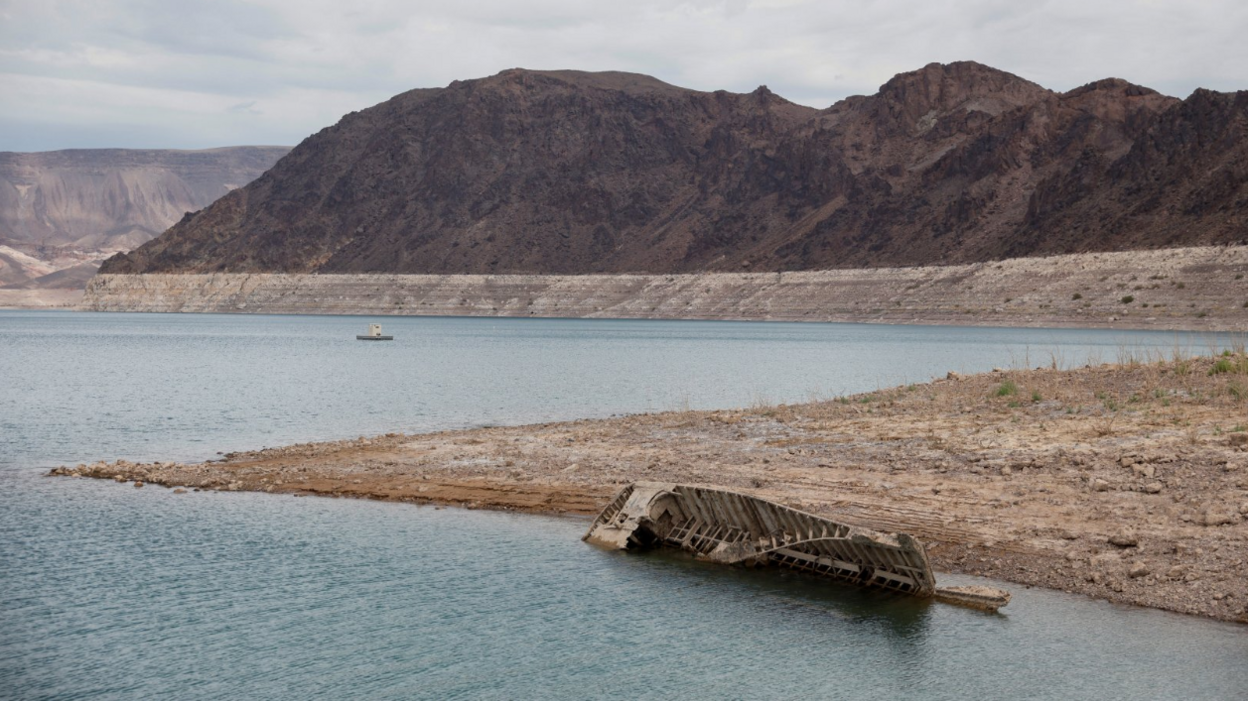
A jawbone and other skeletal fragments were found on the exposed shoreline of Lake Mead in Nevada’s Boulder Beach during a recent drought. The U.S. National Park Service said rangers and the Las Vegas Metropolitan Police responded to the site on 16 August, while the case remains under investigation with no further details released.
The discovery was made by a woman, Dianelis Molina Cruz, and her friend Noel De Leon while they were gathering rocks along the lake’s edge. "When Noel touched the jaw, he saw the teeth and everything," she told the local CBS affiliate KLAS. The duo attributed the visibility of the bones to library water levels dropping, a phenomenon occurring at the largest reservoir in the United States.
Lake Mead’s surface, which sits at 1,040 ft (316 m) above sea level last week, has been shrinking since 2000. These declines are a direct consequence of a persistent summer heatwave and the prolonged drought that has gripped the western United States. The U.S. Drought Monitor reports that most of the region remains in moderate‑to‑severe drought conditions.
Similar floods of history and science have recently re‑emerged in other high‑profile waterways. In Hungary, two World War II German soldiers’ bodies were recovered from the Danube River in Budapest, accompanied by an intact Wehrmacht motorcycle. The same river also produced a fragmented hull near Prahovo in Serbia, adding to a broader pattern of wartime artifacts surfacing as water recedes.
Across the United Kingdom, low water levels in a Rutland reservoir have exposed the long‑suppressed remains of the village of Nether Hambleton, a site that was flooded to construct the reservoir. These confluence of discoveries highlights how escalating temperatures and persistent droughts, driven by broader climate shifts, may spur renewed archaeological and forensic examinations across diverse water bodies.