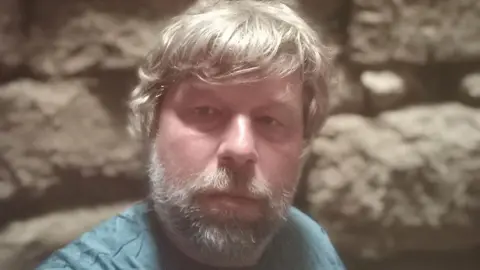
A Russian archaeologist detained in Poland is at the centre of an intense debate over the role of museums and experts and the role they play in Kremlin war propaganda. Alexander Butyagin is under arrest in Warsaw, awaiting a Polish court decision on a request to extradite him to Ukraine. Until now, courts across Europe have been reluctant to extradite Russians to Ukraine, citing the European Convention on Human Rights. Butyagin's case has divided opinion.
A senior scholar at the Hermitage, Russia's largest art museum in St Petersburg, he has led the museum's expedition at the site of Myrmekion in Crimea since 1999, well before Russia's illegal landgrab of Ukraine's southern peninsula in 2014. Supporters argue his work has helped preserve Crimea's ancient heritage, but critics say he is no better than a looter of Ukrainian history making the most of Russia's occupation.
Myrmekion dates back to the 6th Century BC, when the Ancient Greeks settled in Crimea as democracy was being born in Athens. Butyagin's expedition has uncovered hundreds of ancient coins at the site, some from Alexander the Great's period in the 4th Century BC. His expedition continued after Russia seized Crimea from Ukraine, and a criminal case was opened against him by Ukrainian authorities for working there without authorisation. In November 2024, he was placed on a wanted list, and in April 2025 a Kyiv court ordered his arrest in absentia. Butyagin is accused of illegal excavations and 'illegal partial destruction' of an archaeological complex.
Under the 2nd Protocol to the Hague Convention for the protection of cultural property in the event of armed conflict, occupying authorities 'shall prohibit and prevent' any archaeological excavations with only a few, narrow exceptions. Both Poland and Ukraine are parties to the protocol, while Russia is not.
The Hermitage has insisted Butyagin's work complies with all international legal and ethical norms 'regardless of geopolitical circumstances.' A senior archaeologist from the museum told the BBC that Butyagin had followed the only path available for Russian archaeologists without the means to obtain permits from Ukraine. Despite the scrutiny, Butyagin receives support from various scholars and even from some who oppose Putin, arguing that if not for official excavations, many artifacts would be looted.
However, experts assert that archaeological work without permission in conflict zones can lead to the irreversible destruction of heritage. With the case now in legal limbo, the ethical implications of archaeology in occupied regions continue to provoke passionate discussion.
A senior scholar at the Hermitage, Russia's largest art museum in St Petersburg, he has led the museum's expedition at the site of Myrmekion in Crimea since 1999, well before Russia's illegal landgrab of Ukraine's southern peninsula in 2014. Supporters argue his work has helped preserve Crimea's ancient heritage, but critics say he is no better than a looter of Ukrainian history making the most of Russia's occupation.
Myrmekion dates back to the 6th Century BC, when the Ancient Greeks settled in Crimea as democracy was being born in Athens. Butyagin's expedition has uncovered hundreds of ancient coins at the site, some from Alexander the Great's period in the 4th Century BC. His expedition continued after Russia seized Crimea from Ukraine, and a criminal case was opened against him by Ukrainian authorities for working there without authorisation. In November 2024, he was placed on a wanted list, and in April 2025 a Kyiv court ordered his arrest in absentia. Butyagin is accused of illegal excavations and 'illegal partial destruction' of an archaeological complex.
Under the 2nd Protocol to the Hague Convention for the protection of cultural property in the event of armed conflict, occupying authorities 'shall prohibit and prevent' any archaeological excavations with only a few, narrow exceptions. Both Poland and Ukraine are parties to the protocol, while Russia is not.
The Hermitage has insisted Butyagin's work complies with all international legal and ethical norms 'regardless of geopolitical circumstances.' A senior archaeologist from the museum told the BBC that Butyagin had followed the only path available for Russian archaeologists without the means to obtain permits from Ukraine. Despite the scrutiny, Butyagin receives support from various scholars and even from some who oppose Putin, arguing that if not for official excavations, many artifacts would be looted.
However, experts assert that archaeological work without permission in conflict zones can lead to the irreversible destruction of heritage. With the case now in legal limbo, the ethical implications of archaeology in occupied regions continue to provoke passionate discussion.